How to Choose the Right Size Dog Bed: A Step-by-Step Guide for Every Breed
How to choose the right size dog bed in 5 steps: measure your dog, match sleeping style, check fill type, and avoid the most common buying mistakes.

Why Getting the Size Right Actually Matters
- Why Getting the Size Right Actually Matters
- Step 1: Measure Your Dog Properly
- Step 2: Identify Your Dog’s Sleeping Style
- Step 3: Factor in Your Dog’s Age and Joint Status
- Step 4: Match Fill Type to Your Dog’s Needs
- Step 5: Check Washability and Durability
- Which Pelsbarn Bed Is Right for Your Dog?
- Frequently Asked Questions
Buying a dog bed should be simple. You would think: pick a size that roughly fits the dog, add it to cart, done. Yet the number of dog beds that end up folded in a corner — abandoned because the dog refuses to use them — suggests the decision is trickier than it looks.
Most dogs reject beds not because of quality, but because of fit. A bed that is too small leaves your dog hanging over the edge. One that is too large makes anxious or small-breed dogs feel exposed and unsettled. A bed with the wrong fill for your dog’s joints or sleeping position fails at the one job it is supposed to do.
This guide walks through exactly how to choose the right size dog bed in five practical steps — covering measurement, sleeping style, fill type, and how to apply it all to real products like the Pelsbarn range.
Why Getting the Size Right Actually Matters
It is worth spending a moment on the “why” before the “how,” because understanding the consequences of a mismatch makes the steps feel less pedantic.
A bed that is too small forces dogs to curl into an unnatural position, compressing the spine and putting excess pressure on limbs. For dogs who naturally sleep stretched out — many large breeds, greyhounds, retrievers — a small bed is not just uncomfortable, it is actively counterproductive compared to sleeping on the floor.
A bed that is too large creates a different problem. Small dogs and breeds prone to anxiety, like Chihuahuas, Dachshunds, and Shih Tzus, prefer enclosed, snug spaces. A vast open bed provides no sense of security. These dogs will often choose a corner of a couch or a laundry basket instead.
A fill that is wrong for the dog’s age or body can exacerbate joint problems or fail to prevent them. A young, healthy dog on a firm orthopedic fill will be fine. A ten-year-old Labrador on a thin polyester mat is sleeping on an instrument of injury.
Get the size and fill right, and your dog uses the bed. Get them wrong, and you have a decorative item.
Step 1: Measure Your Dog Properly
The first thing to know: bed size labels — Small, Medium, Large, XL — vary wildly between brands. A Large from one manufacturer is a Medium from another. Always compare your dog’s actual measurements against the bed’s internal dimensions, not the size label.
Measurement 1: Nose-to-tail length
With your dog lying down in their natural sleeping position, measure from the tip of the nose to the base of the tail (not including the tail itself). This gives you the minimum bed length required.
Measurement 2: Shoulder-to-floor height
With your dog standing, measure from the floor to the top of the shoulder. This tells you whether the sides or bolsters of a higher-walled bed will be proportionate.
Measurement 3: Body weight
This affects fill compression. A 40 kg dog will compress a standard fill far faster than a 10 kg dog. Heavier dogs need denser fills or specifically orthopedic construction to maintain support over time.
The rule of thumb: add 15-20 cm (about 6-8 inches) to your dog’s nose-to-tail measurement for the minimum recommended bed length. This leaves room for the dog to stretch slightly without hanging over the edge — the ideal position.
Breed shortcut if you cannot measure:
For a quick baseline, use these common measurement ranges by breed type:
- XXS (up to 30 cm): Chihuahua, Yorkshire Terrier, Toy Poodle
- XS/S (30–50 cm): French Bulldog, Dachshund, Pug, Miniature Schnauzer
- M/L (50–75 cm): Beagle, Border Collie, Labrador (petite), English Cocker Spaniel
- XL (75–90 cm): Labrador, German Shepherd, Rottweiler, Dalmatian
- XXL (90+ cm): Great Dane, Saint Bernard, Irish Wolfhound, Mastiff
Pelsbarn covers this full range — XXS through XXL — with specific internal dimensions listed for each size in their product pages.
Step 2: Identify Your Dog’s Sleeping Style
Sleeping position is the second key variable, and it directly affects which shape of bed to buy.
The Curler
Curlers — dogs who tuck their legs under and sleep in a tight oval — do best in round or oval beds with raised bolsters around the perimeter. The bolster gives them something to lean against and reinforces the curled position they naturally seek. They often prefer a slightly smaller footprint bed than their measurements would suggest, because the curled posture takes up less space.
The Stretcher
Stretchers — dogs who sleep fully extended on their side or front — need the most linear space. A bolstered or donut-style bed will frustrate them. Flat rectangle or oval mattress-style beds are the right shape. Pelsbarn’s Originals and Orthopedic beds are primarily flat-profile designs, which suits stretchers well.
The Leaner
Some dogs — especially anxious breeds or dogs adapting to a new home — like to sleep with one side pressed against something: a wall, a sofa leg, a pillow. For these dogs, a bed with at least one raised bolster gives them the contact point they seek. Placing the bed in a corner can also help.
The Burrower
Burrowers — including most Dachshunds, Huskies in cold climates, and many terrier types — want to push under something. A calming blanket placed over or beside the bed satisfies this instinct without requiring a specialist cave bed. This is one practical reason the Pelsbarn Originals bundle with the free calming blanket is popular among Dachshund owners.
Step 3: Factor in Your Dog’s Age and Joint Status
This step is the one most commonly skipped — and it is the step that prevents the most expensive mistakes.
Puppies (under 2 years): Young dogs have high energy, bounce between positions frequently, and do not yet have joint concerns. A well-made standard-fill bed is entirely adequate. There is no need to spend on therapeutic orthopedic fill for a healthy dog under two.
Adult dogs in good health (2–7 years): The Pelsbarn Originals and similar natural-fill beds are ideal for this group. Good support, durable construction, no excess spend on medical features that are not yet needed.
Senior dogs (7+ years) or any dog with joint concerns: This is where orthopedic fill becomes a genuine health decision, not a marketing upsell. A standard fill compresses under weight and provides flat support — meaning pressure concentrates at the dog’s heaviest points (hips, shoulders, elbows) rather than distributing across the surface. Orthopedic fill — particularly the dense, pressure-redistributing construction used in the Pelsbarn Orthopedisch Hondenbed — addresses this by spreading load across the surface and relieving the concentrated pressure points.
Signs your dog needs orthopedic support:
– Stiffness after getting up, especially in the morning
– Reluctance to lie down or get up from their current sleeping spot
– Circling and repositioning repeatedly before settling
– Favoring one side when sleeping
– Older large breeds, even without obvious symptoms
For these dogs, spending an extra €26 on the Pelsbarn Orthopedisch Hondenbed over the Originals is one of the most meaningful investments in their comfort and joint health.
Step 4: Match Fill Type to Your Dog’s Needs
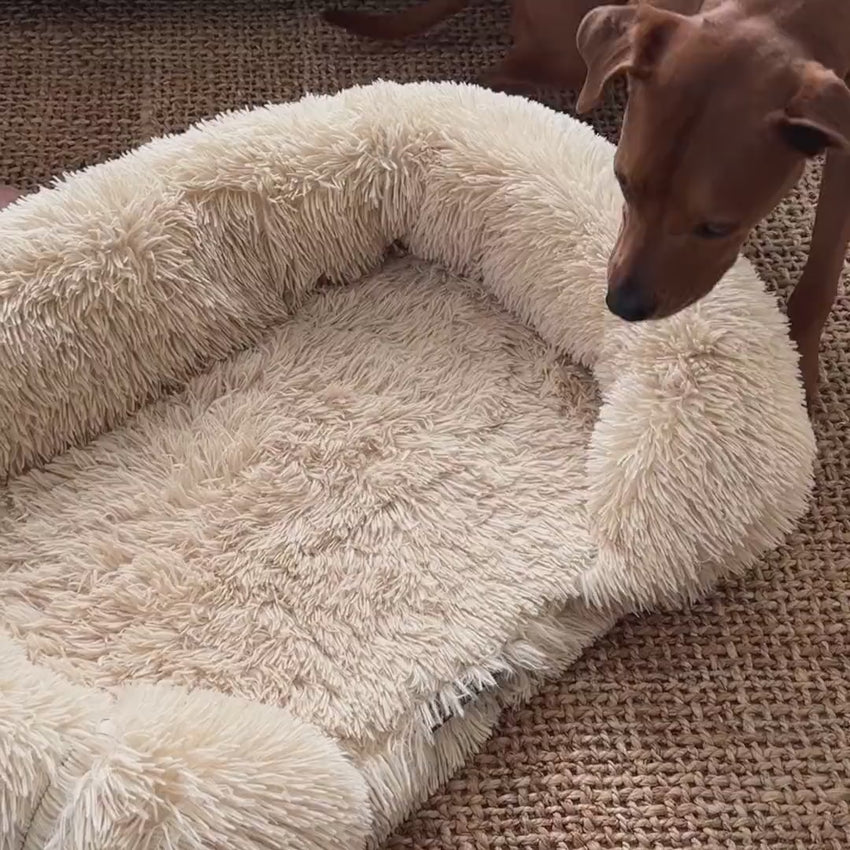
The fill is what distinguishes a good bed from a great one — and it is where the market is most confusing.
Polyester / synthetic fiberfill: The cheapest option. Compresses quickly (within months under a large dog) and does not recover. Fine as a temporary solution or for very small, light dogs. Not worth spending significant money on.
Natural fills (cotton, wool, natural fibers): More expensive but far more durable. Natural materials resist compression better than synthetic alternatives and regulate temperature more effectively — cooler in summer, warmer in winter. Pelsbarn uses natural fills in both the Originals and Orthopedic models. This is the meaningful step up from mass-market beds.
Memory foam: The premium human mattress material, adapted for dogs. True memory foam responds to body heat, conforms to shape, and provides consistent pressure relief. It is the best clinical option for dogs with diagnosed joint disease. However, not all pet beds labeled “memory foam” contain actual memory foam — the term is used loosely. When it matters medically, check the specification carefully.
Orthopedic fill: A broader term that includes dense layered foams, natural ortho-grade materials, and high-density foam bases. The Pelsbarn Orthopedisch Hondenbed uses orthopedic-grade fill that is meaningfully firmer and more structured than the Originals, providing the pressure distribution needed for joint support.
Step 5: Check Washability and Durability
Size and fill get most of the attention, but washability is what determines whether a bed stays hygienic for its full lifespan — or becomes a bacterial repository within months.
Removable covers: Non-negotiable if you care about hygiene. The cover should zip off cleanly for machine washing. A bed without a removable cover either needs to be hosed down (awkward, often insufficient) or replaced more frequently.
Washing temperature: Pet dander, saliva, and oils require a minimum of 40°C to break down effectively. Check that the cover fabric can handle at least a 40°C cycle without shrinking or pilling.
Frequency: For most dogs, washing the cover every 2-4 weeks is sufficient. Increase frequency for heavy shedders, dogs that go outside frequently, or dogs that drool.
The Pelsbarn approach: Both the Originals and Orthopedic models use removable, washable covers. The covers hold up to regular washing without significant pilling or dimensional change, which is consistent with the natural textile quality in the rest of the construction.
Which Pelsbarn Bed Is Right for Your Dog?

Putting all five steps together, here is how the Pelsbarn range maps to dog type:
Pelsbarn Originals Bundle (€63, 44% off) — Best for:
– Dogs under 7 years in good health
– Any weight, XXS through XXL
– Stretchers and curlers alike
– Dogs with mild anxiety who will benefit from the free calming blanket
– Buyers who want excellent natural-fill quality at the best available price
Pelsbarn Orthopedisch Hondenbed (€89, 16% off) — Best for:
– Senior dogs (7+)
– Large and giant breeds even in adult years (preventative joint support)
– Any dog showing early signs of stiffness or joint discomfort
– Dogs with diagnosed joint conditions
– Buyers who want the highest-performance option in the range
Pelsbarn Auto Hondenmand 2.0 (€61, 44% off + free safety belt) — Best for:
– Dogs who travel frequently by car
– Owners who want a dedicated car-safe surface that anchors in place
– Dogs that are anxious in the car and need a familiar, padded surface
For a more detailed breakdown of the Originals vs Orthopedic decision, the Pelsbarn dog bed review covers both models side by side. For the current deal pricing and the charity impact behind every purchase, see the full Pelsbarn orthopedic dog bed review.
See the full Pelsbarn range and choose your size →
Frequently Asked Questions
What happens if I buy the wrong size?
The most common mismatch is buying too small. Dogs will typically refuse to use a bed that cuts their natural sleeping position short. If you are between sizes, always go up. A slightly large bed is never a problem; a slightly small bed is almost always rejected.
Can I use the dog bed size chart from one brand on another brand’s products?
No — size labels vary between brands. Always compare your dog’s actual measurements against the specific bed’s stated internal dimensions. Do not rely on size labels (S, M, L) as a consistent standard across brands.
How often should I replace a dog bed?
A well-made natural-fill bed from a brand like Pelsbarn typically lasts 3-5 years with regular cover washing. Signs it is time to replace: the fill no longer recovers after compression (stays flattened), the cover cannot be cleaned effectively, or the dog stops using it — dogs are often the most honest signal that support has gone.
Does the orthopedic fill matter for puppies?
For most puppies under two years without any diagnosed joint condition, it does not — and it is not worth the extra spend. Save orthopedic fill for the life stage where it provides real clinical benefit: senior dogs and large breeds entering middle age.
Is the Pelsbarn calming blanket sold separately?
The calming deken is included free with the Originals bundle and is not listed as a standalone product. The 44% off bundle is currently the only way to get it at this price.
Recommended for you
 Pelsbarn Dog Bed Review 2026: Originals vs Orthopedic — Which Is Right for Your Dog?
 Pelsbarn Orthopedic Dog Bed Review: Is the 44% Off Deal Worth It?
 Single-Protein Dog Treats: How to Switch an Allergy-Prone Dog (2026 Guide)
 Escapure Hupferl Review 2026: Are These 98% Horse-Meat Treats Worth It?
 Best Air-Dried Dog Treats in 2026 (And the 98%-Meat One Owners Keep Repurchasing)
 Still Using Plastic Poop Bags? Here’s Why to Stop Today